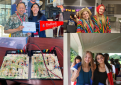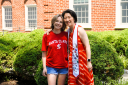

Madeira Biology Teacher Amber Saville-Andree traveled deep into the Peruvian Amazon this summer to work alongside scientists, study rainforest biodiversity, and explore new ways to engage Madeira students in environmental research.
For Ms. Saville-Andree, whose academic background is in marine science, the experience offered an opportunity to immerse herself in an entirely different ecosystem.
“I thought, ‘What is the most opposite thing that I could do?’” she said. “The marine habitat has no amphibians, so working with frogs is the most opposite I can be.”
Reaching the remote field station required traveling more than 100 miles by boat from Iquitos along the Amazon River before transferring to a smaller boat capable of navigating a narrow creek through the rainforest.
At the station, Ms. Saville-Andree joined a research team studying whether noise from the facility’s generator affects nearby frog populations and behavior. The team conducted daytime and nighttime surveys along designated paths, carefully capturing, measuring, photographing, and identifying the frogs they encountered.
Researchers also placed small programmable recording devices called AudioMoths throughout the study area. The recordings allowed them to document the rainforest’s soundscape and compare the frequencies produced by the generator with those frogs use to communicate.
The experience introduced Ms. Saville-Andree to new field-research methods and technology while letting her participate in the full scientific process, from collecting and analyzing data to writing a field report and presenting the team’s findings.
Participants also learned about the people who call the rainforest home. During a visit with a nearby Maijuna community, they explored local culture and conservation practices, including stingless-bee keeping. The Indigenous Maijuna people continue to steward nearly one million acres of rainforest in the region.
“Even though it seems like we’re in the middle of nowhere, this is still habitat and home to lots of creatures, as well as people,” Ms. Saville-Andree said.
Throughout the program, Ms. Saville-Andree considered how the experience could inspire new opportunities at Madeira. The School’s 376-acre campus provides students with abundant possibilities to study plants, birds, insects, waterways, and other indicators of environmental health.
Tools such as environmental sensors, interactive mapping platforms, sound recorders, iNaturalist, and eBird could help students document campus biodiversity, monitor changes over time, and contribute their observations to greater scientific efforts.
The resulting research could also extend beyond biology.
“I would love to be able to have the statistics class use actual environmental data that we’re collecting here on campus,” Ms. Saville-Andree said.
Students could analyze data, create interactive maps, study the effects of human activity, or use digital storytelling to communicate their findings. Along the way, they would also confront important ethical questions, including when the location of a rare or vulnerable species should be protected.
Ms.Saville-Andree returned from Peru with firsthand experience in active scientific research, new technologies to explore, and an expanded vision for turning Madeira’s campus into a living laboratory.